Reliability suffers from ambient conditions, weather and track conditions.
THE CHALLENGE
Brake distance testing the old way
Challenges that cost time and resources
Unreliable equipment, lengthy setup and inaccurate results make brake tests on rail vehicles harder than they need to be. Maintenance supervisors, technicians and engineers often have to work with cumbersome systems that are neither accurate nor efficient. The result: delays, repeated runs and rising cost.
Inaccurate results
Lengthy setup
Long setup times with GNSS, radar or fifth-wheel systems.
Time-consuming execution
Several people needed, manual evaluation, inefficient procedures.
Manual documentation
Error-prone, slow, and values copied by hand.
THE SOLUTION
Brake distance testing redefined:
The TMX solution
The TMX solution removes those obstacles. It combines an optical-inertial sensor with an intuitive app to make brake distance tests faster, more accurate and easier to run. One sensor, a rugged data acquisition case and wireless operation: everything you need for a smooth test.
Your benefits
Time
Fast setup and intuitive app control save time and resources.
Accuracy
Reliable, high-accuracy results independent of satellite reception, weather and track conditions.
Flexibility
Wireless operation, guided test sequences and adaptable workflows.
Traceability
A fully digital chain from measurement to report: no paper, no manual transfer.
The optical sensor gives us the reliability we need for tests to standard, regardless of weather or environment. At the same time, the software gives us the freedom to develop our own test scenarios.
— Philipp Humbel, quality and systems engineer, VBZ central workshop

YOUR NEXT STEP
Optimize your brake distance testing now
See how our app-based system makes your brake tests faster, simpler and more accurate. Contact us for a quote or a live demo.
Operations, maintenance and development
Our solution is for transit operators and rail vehicle manufacturers who need accurate brake distance measurements, whether for recurring tests under national regulations, development tests or commissioning. One system that makes the test process simpler, more efficient and more accurate.

Transit operators
For recurring brake tests on trams, streetcars, light rail vehicles, metros and commuter trains, as part of maintenance and after work on the brake system.
- Brake distance tests to the applicable regulations (developed for the German BOStrab and TR Br, adaptable to other national rules)
- Brake distance, deceleration and speed in one system
- Fast setup, standalone operation, guided test sequences
- Uniform documentation and automatic test reports
- Shorter test times through efficient execution

Rail vehicle manufacturers
For development, type and commissioning tests on rail vehicles with high demands on accuracy and repeatability.
- Externally calibrated measuring instrument for development and approval tests
- Flexible test configuration for different speeds, brake types and load conditions
- Repeatable results independent of wheel slip, track surface and satellite reception
- Suitable for prototypes, comparative and acceptance measurements
REFERENCE
Proven at Zurich Public Transport (VBZ)
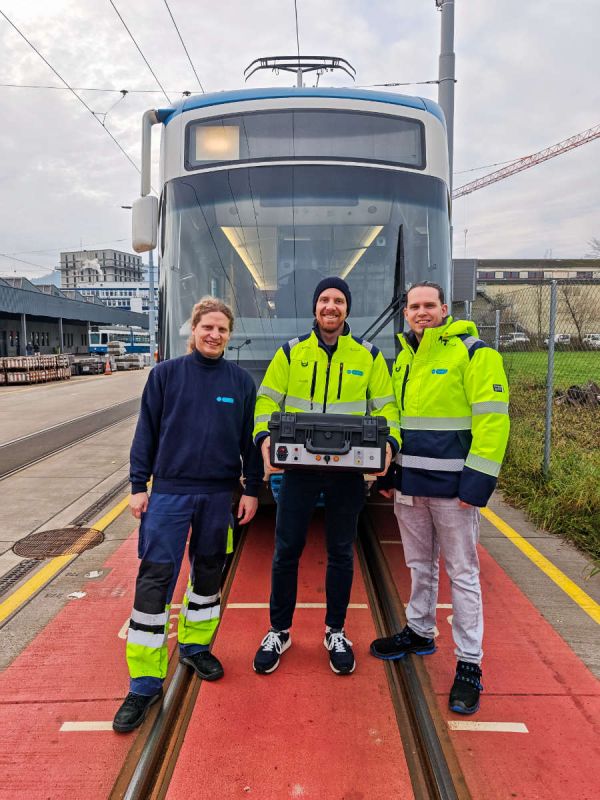
Zurich Public Transport (VBZ) uses the TMX BrakeTest system across its entire tram fleet. With eight systems at three depots and the central workshop, VBZ runs around 500 brake distance tests a year on more than 230 vehicles: standardized, compliant and efficient.
Our technicians adopted the new solution immediately. Operation via iPad is intuitive, and the live display makes the work easier and safer. The automatic report generation in particular saves us a lot of time: from test to documentation it is now one continuous, efficient process.
– Michael Fink, Head of Tram Maintenance, Zurich Public Transport
SOLUTION DETAILS
Technology that delivers
Our brake distance measurement system combines a high-precision optical sensor, rugged data acquisition and intuitive wireless operation. All components are matched to each other for smooth interaction and reliable tests.
Optical sensor
Accurate distance measurement in all conditions
The optical sensor, which we use in cooperation with our partner Sensoric Solutions, measures distance without contact and without slip thanks to sensor fusion of optical technology and an inertial measurement unit (IMU). Results are repeatable even in rain, snow or on uneven track, and no satellite reception is needed. Mounted with a magnetic holder or suction cup, it is quick to fit and cuts setup time considerably. The system captures brake distance and deceleration, the key quantity for proving that permissible deceleration values are met to protect passengers.
- Non-contact, slip-free measurement with sensor fusion (optical + IMU)
- Speed measurement non-linearity below ±0.1 % FS
- Quick mounting with suction cup or magnetic holder
Rugged data acquisition
Mobile and flexible
The compact data acquisition system is designed specifically for brake distance tests. It works standalone in a rugged protective case and connects wirelessly over WLAN. It runs on a wide range of supply voltages and, optionally, fully on a swappable battery, ideal for mobile use.
- Standalone DAQ system in a compact protective case
- Direct connection for the optical sensor and the brake trigger
- Wireless connection over WLAN
- Wide supply voltage range (14 to 160 V DC, covering 24, 72, 110 V vehicle supplies)
- Optional battery operation with swappable power tool battery
TMX BrakeTestApp
Guided operation
The app guides the user through the entire test process: configuration, execution and automatic evaluation. Live data is displayed clearly, and test reports are generated directly as PDF. Integrated vehicle and template management makes typical test sequences quick to set up and easy to adapt. The app runs on smartphone, tablet and notebook and connects to the DAQ over WLAN. Several devices can connect at once, so the driver gets a display of their own with all the information they need.
- Guided test sequences with live data display
- Automatic PDF reports
- Vehicle and template management
- Adaptable to specific requirements
- Runs on tablet, smartphone and notebook
- Multi-user operation
Templates
Save time on every test
For each vehicle type you create one template in the TMX BrakeTestApp, defining all required brake applications with their criteria: initial speed, brake distance and deceleration. When a specific vehicle is due for testing, a test campaign is created from the template with a few taps. Only the vehicle-specific data is added: vehicle number, inspector and ambient conditions. All brake applications and criteria are taken over automatically. A standardized template becomes a complete, compliant brake test in seconds, which saves time and prevents input errors.
- One template per vehicle type with all brake applications and test criteria
- Criteria such as initial speed, brake distance and deceleration stored in the template
- Test campaign created from the template with a few taps
- Only vehicle-specific data to add (vehicle number, inspector, ambient conditions)
- Saves time, prevents input errors: a compliant test in seconds
Technical data
The TMX BrakeTest system measures brake distance, deceleration and acceleration without contact and without slip. It consists of the optical-inertial sensor OMS 4, a portable DAQ case and the platform-independent TMX BrakeTestApp.
System overview
| Measured quantities | speed, distance, brake distance, deceleration, acceleration |
| Measuring principle | optical-inertial (spatial filter + inertial sensors), non-contact, slip-free |
| Brake start detection | automatic via the vehicle's brake trigger signal; manual trigger as alternative |
| Connectivity | WLAN (operating devices); sensor via CAN 2.0B |
Sensor
| Speed range | 250 / 400 km/h (selectable) |
| Non-linearity | < ±0.1 % FS |
| Optical resolution | approx. 0.6 mm |
| Update rate | 1000 Hz |
| Acceleration / rate range | ±20 g / ±500 °/s |
| Operating temperature | -25 to 50 °C |
| Protection class (sensor / ECU) | IP68 / IP40 |
| Calibration | factory calibration; recommended interval 24 months |
DAQ case
| Design | portable, shock-resistant case with connection panel |
| Supply voltage | 14 to 160 V DC |
| Power supply | Bosch GBA 18 V swappable battery (standalone), approx. 3.5 h with 5 Ah battery |
| Weight | 12 kg |
| Dimensions (W×H×D) | 48.8 × 22.9 × 38.6 cm |
TMX BrakeTestApp
| Platforms | Windows (10 or later), Android (11 or later), iOS optional |
| Evaluation | automatic pass/fail with traffic-light logic; v–t, s–t, v–s diagrams |
| Report | PDF in standard layout, customer logo can be included |
| Brake values | initial speed, brake distance, brake duration, deceleration, MFDD (10–90 %) |
| Suitable vehicles | all rail vehicles and special vehicles (road-rail vehicles) |
Full data sheet (PDF, German): all technical data on sensor, DAQ case and TMX BrakeTestApp in detail.
Standards, approval and traceability
Brake distance measurements are safety-relevant and subject to clear regulatory requirements. Operators and manufacturers must document results in a way that is traceable, repeatable and auditable, in regular operation as well as for acceptance, maintenance and approval procedures.
The TMX BrakeTest system was developed for brake tests under the German BOStrab and the associated Technical Rules on Brakes (TR Br) for trams and light rail. Its test logic, templates and limit values adapt to the applicable national regulations and operator rules in other countries, for example the Swiss Federal Office of Transport requirements at VBZ. At the same time, the system is suitable for development, type and comparative measurements at manufacturers, where accurate, externally calibrated instruments are required.
Optical distance and speed measurement delivers repeatable results independent of wheel slip, track surface and satellite reception. Combined with guided test sequences, unambiguous evaluation and automatic PDF reports, this creates continuous, audit-proof documentation, as a basis for internal quality assurance and for evidence to authorities and assessors.
We support:
- BOStrab / TR Br (trams and light rail, Germany); comparable national rules on request
- Development and approval tests at OEMs
- Calibrated instruments, optionally with DAkkS-accredited calibration
- Uniform, auditable PDF reports
Frequently asked questions
The vehicle accelerates to a defined initial speed and the driver applies the brake. From the moment the brake trigger signal is detected, the system records distance, speed and deceleration until standstill and compares the result with the limit values of the template. With TMX BrakeTest, distance and speed come from an optical-inertial sensor mounted on the vehicle body; nothing is derived from wheel rotation or satellite reception.
Yes. The sensor measures against the ground and is mounted to the vehicle body, so it is independent of vehicle type, wheel diameter and on-board systems. Trams, streetcars, light rail vehicles, metros, commuter and regional trains, locomotives and road-rail vehicles can all be tested with the same equipment.
The system was developed for the German BOStrab and TR Br. Test sequences, speeds and limit values are defined in templates, so the rules of other countries or individual operators can be set up without changing the hardware. Zurich Public Transport, for example, tests to the requirements of the Swiss Federal Office of Transport.
GNSS needs a clear view of the sky and often fails in tunnels, depots and built-up areas. Wheel-based signals are affected by slip, especially during emergency braking. An optical-inertial sensor measures the movement of the vehicle relative to the ground directly, which is why the result is repeatable in all these situations and can be calibrated independently of the vehicle.
Mounting the sensor with a magnetic holder or suction cup, connecting one cable to the DAQ case and picking up the brake trigger signal typically takes a few minutes. The case runs on its own battery, and the app connects over WLAN.
Vehicle data, inspector, ambient conditions, every brake application with initial speed, brake distance, brake duration, deceleration and MFDD, the pass/fail result against the template limits and the v–t, s–t and v–s curves. The report is generated directly from the measured data as a PDF; no value is copied by hand.
Still have questions? Get in touch.
BACKGROUND
Technical article
Our Brake Test system was featured in the 2025 edition of "Intern", the journal of the German association of public transport maintenance supervisors (FVM).
The four-page article (in German) shows how the optical-inertial measurement concept, the mobile DAQ case and the app-based software make brake distance tests to standard faster, more accurate and easier.
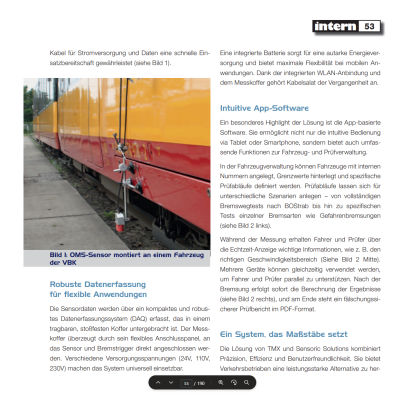
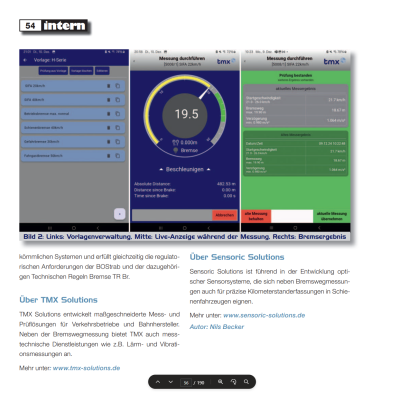
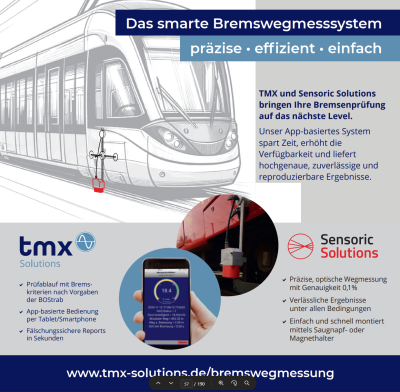
Curious? Read the full digital version of the article (German) at https://www.fvm-ev.de/intern/intern_2025, from page 54.
CONTACT
Your next step
Want to know whether the TMX BrakeTest system fits your requirements? We'll show you the solution in detail, in a live demo if you like.
Copyright 2026 TMX Solutions. All rights reserved.
Settings saved
Privacy settings
This website may use cookies for statistics and marketing purposes.
The following cookies may be set depending on your settings:
user_privacy_settings
| Domain name: | tmx-solutions.com |
| Expiry: | 30 days |
| Storage: | Local storage |
| Description: | Stores the privacy settings from the "Privacy Manager" consent tool. |
user_privacy_settings_expires
| Domain name: | tmx-solutions.com |
| Expiry: | 30 days |
| Storage: | Local storage |
| Description: | Stores the expiry of the privacy level settings from the "Privacy Manager" consent tool. |
ce_popup_isClosed
| Domain name: | tmx-solutions.com |
| Expiry: | 30 days |
| Storage: | Local storage |
| Description: | Stores that the user closed the popup (content element "Popup"). |
Eclipse.outdated-browser: "confirmed"
| Domain name: | tmx-solutions.com |
| Expiry: | 30 days |
| Storage: | Local storage |
| Description: | Stores the state of the "Outdated browser" notice bar. |
Close
You are using an outdated browser. The website may not be displayed correctly.