Accelerations up to 5,000 g, vibration, deformation: standard DAQ systems fail here
THE CHALLENGE
Why battery crash tests need special measurement technology
Electric mobility is growing fast. New battery gigafactories open every month, cell capacities rise rapidly, and new cell chemistries such as LFP, NMC and solid-state systems are fundamentally changing the requirements for design, safety and testing. With higher energy density and growing system complexity, the need for precise, fail-safe measurement solutions grows too, above all in crash and safety validation.
Extreme mechanical loads
Electrical safety
HV voltages up to 1,200 V have to be measured with galvanic isolation, and the measurement system must not compromise the insulation of the battery system.
Validation to standards
UN GTR No. 20, FMVSS 305a and UN ECE R100 Rev. 3 require precise evidence of residual voltage, insulation resistance and the tripping of safety systems
Data complexity
Mechanical parameters (acceleration, force, deformation), electrical parameters (voltage, current, insulation) and temperature have to be captured synchronously
What has to be evaluated in battery crash tests
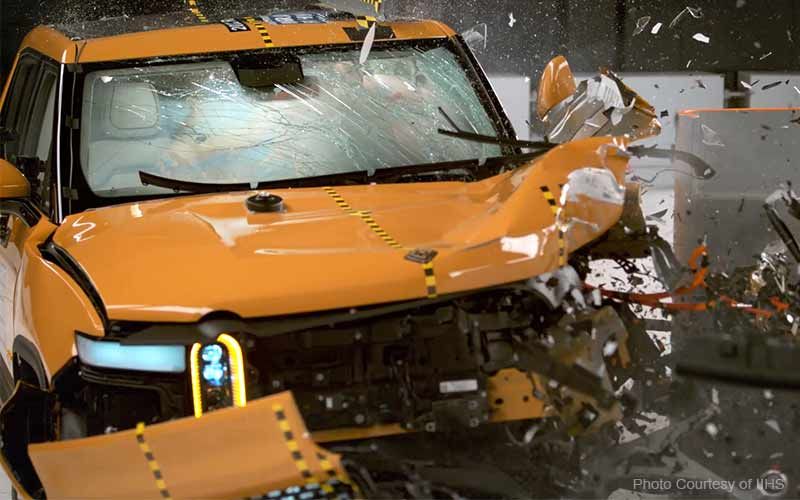
Battery crash and sled tests are not about a single measured value. They are about evaluating the safety-relevant functions and states of the battery system after the crash event. Capturing these aspects is the basis for the safety and compliance assessment of the battery system.
Typical tests
- Electrical safety after the crash: are dangerous voltages still present, did the system disconnect reliably?
- Insulation from the vehicle chassis: does the separation of the HV conductors survive the deformation?
- Mechanical integrity: do housing and mounting respond robustly, do interfaces remain functional?
- Thermal behavior: are there local hot spots or early signs of thermal runaway?
- Timing: when do contactors, pyro fuses or disconnects act, in the millisecond range?
Relevant standards and safety requirements
The electrical safety of high-voltage batteries after a crash is strictly regulated internationally. Manufacturers must prove that no dangerous residual voltage is present, that insulation remains intact and that all protection systems have tripped reliably. For the design of the measurement technology and the validation of test results, these regulations are most relevant:
Key regulations
- FMVSS 305/305a – electrical safety after crash (residual voltage, insulation, electrolyte leakage)
- UN ECE R100 Rev. 3 – REESS safety requirements for rechargeable energy storage systems
- UN GTR No. 20 (EVS) – global technical regulation on electric vehicle safety
- ISO 6469-3/-4 – protection against electric shock and post-crash requirements
Limit values and measurements
- Residual voltage after crash: < 60 V DC / < 30 V AC
- Insulation resistance: > 100 Ω/V
- Safety systems: tripping of pyro fuses, contactors, HV interlocks
- Structural integrity: no electrolyte leakage, temperature monitoring
Test setup for crash and sled tests
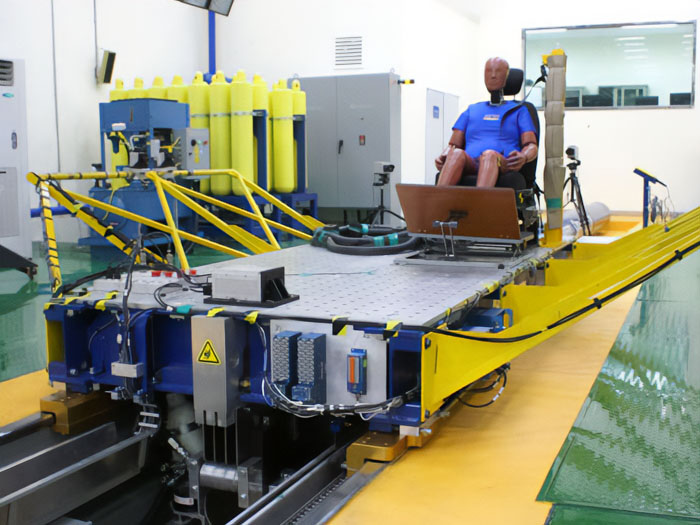
The test setup for battery crash and sled tests is derived from the respective safety and validation goals. What matters is that all safety-relevant states of the battery system can be captured reliably during and after the crash. All measurement systems have to be triggered together so that mechanical, electrical and thermal effects can be correlated correctly in time. Data is acquired as close to the measuring point as possible, with autonomous data storage, to ensure high data quality even under extreme shock and vibration.
Mechanical measurement
Capturing structural changes and loads on vehicle structure and battery during the crash event
High-voltage monitoring
Galvanically isolated measurement of the HV conductors against the vehicle chassis to evaluate voltage decay and insulation.
Thermal monitoring
Temperature measurement on critical battery components to detect local hot spots and anomalies.
Dummy measurement
Separate acquisition of accelerations and injury criteria in the crash test dummy.
Note: the actual design depends on channel count, signal types, sampling rates and the relevant standards and OEM specifications.
Our approach at TMX Solutions
TMX Solutions supports you in planning and implementing your battery crash tests, vendor-independent and application-oriented. Our focus is a holistic measurement concept that combines safety, measurement quality and practicality.
Typical services
- Analysis of test requirements and relevant standards
- Definition of measured quantities, sampling rates and trigger logic
- Design of distributed DAQ architectures
- Integration of galvanically isolated high-voltage measurement systems
- Support with trigger and synchronization concepts
- Evaluation to ISO 6487 and SAE J211
Vendor-neutral, solution-oriented
We select the measurement technology to fit the task. In projects we rely, among others, on proven systems from DTS (Diversified Technical Systems) when they are the best technical fit.
DEEP-DIVE
Application note: battery crash testing
For a detailed technical look, we provide a comprehensive application note.
It describes typical test setups, relevant standards and example measurement concepts for battery crash tests and safety tests.
Planning battery crash or sled tests?
We support you in designing your measurement solution, from the first concept to implementation in the test. Together we clarify which measurement technology makes sense for your application.