Braking distance measurement on trams: methods, regulations, practice
What BOStrab and the German Technical Rules for Brakes require, when testing is mandatory, and how to document results that hold up. This article covers the German regulations; requirements in other countries differ.
What is braking distance measurement under BOStrab?
Braking distance measurement records the braking distance of a rail vehicle (called stopping distance in BOStrab), i.e., the distance from brake application to standstill, and calculates the mean deceleration from it. For trams and other systems covered by the German Regulations on the Construction and Operation of Light Rail Transit Systems (BOStrab), it proves that braking performance meets the limits of BOStrab and the associated Technical Rules for Brakes (TR Br); TR Br also calls it brake distance testing. The standard case is periodic testing during maintenance. Measurements are also required when new or substantially modified vehicles are commissioned.
In public transit, regular brake testing is one of an operator's core tasks. It ensures safety and regulatory compliance in service. Beyond this operational proof, the measurement data serve as the basis for determining liability after an accident.
When is braking distance measurement on trams required?
For transit operators, the standard case is periodic testing as part of maintenance. Under § 57 BOStrab, maintenance includes servicing, inspection, and repair; inspections must be carried out at fixed, regular intervals. Brake measurements are due in particular after work on the brake equipment and after complaints about braking performance. A vehicle must also be tested after an accident if safety-relevant parts were damaged. The operator sets the specific intervals based on vehicle type and duty.
Less frequent, but also mandatory, is the measurement when new or substantially modified vehicles are commissioned. Before entering service, they need an operating approval from the technical supervisory authority (§ 62 BOStrab). TR Br governs the technical brake verification for this through type testing (first vehicle of a series) and routine testing (every further vehicle in the series).
TR Br also specifies how often to brake: at least three successful stops per brake application in type testing and at least two in routine testing, each on straight, level track.
Which brake applications and speeds are tested?
Testing covers the safety-relevant brake applications defined in BOStrab and TR Br, including service braking, emergency braking, and passenger emergency braking. If the same brake systems are used in the same combination for several brake applications, a brake distance test of the application with the highest requirement is sufficient; the others are covered by functional tests.
The initial speeds are not fixed. They depend on the vehicle: testing takes place at one third and two thirds of the vehicle's maximum design speed.
Example: For a vehicle with a top speed of 80 km/h (50 mph), that is about 27 and 53 km/h (17 and 33 mph). For service and emergency braking, type testing adds the full speed: 80 km/h in this example, but limited to 70 km/h (43 mph) for emergency braking. The initial speed must be held within ±5 km/h (±3 mph).
Measurements take place on straight, level track in the operator's network. The mean deceleration is calculated from the stopping distance and must meet the BOStrab limits for each brake application and initial speed.
Challenges in practice
Despite its importance for safety, braking distance measurement poses real challenges for transit operators. Many of the technologies in use today, such as towed measuring wheels, radar, GPS, or on-board systems, are considered inaccurate, unreliable, labor-intensive, or outdated. With on-board brake measurement systems in particular, one question is getting attention that has so far been answered inconsistently: what requirements must the measurement equipment itself meet, especially regarding calibration and traceable measurement values?
There is no uniform nationwide rule on this in Germany; some supervisory authorities explicitly see a need for clarification. From an evidence standpoint, there are good reasons to rely on systems that can be calibrated independently. In addition, many operators still record, document, and evaluate brake data manually. That process ties up resources, is error-prone, and extends test times. With rising demands on efficiency, traceability, and test documentation, operators need digital solutions that deliver accurate data and fit easily into existing workflows.
The TMX solution
TMX developed a braking distance measurement system that addresses these challenges directly. It consists of an optical sensor, rugged portable data acquisition in a carrying case, and an intuitive app.
Optical sensor for distance and speed
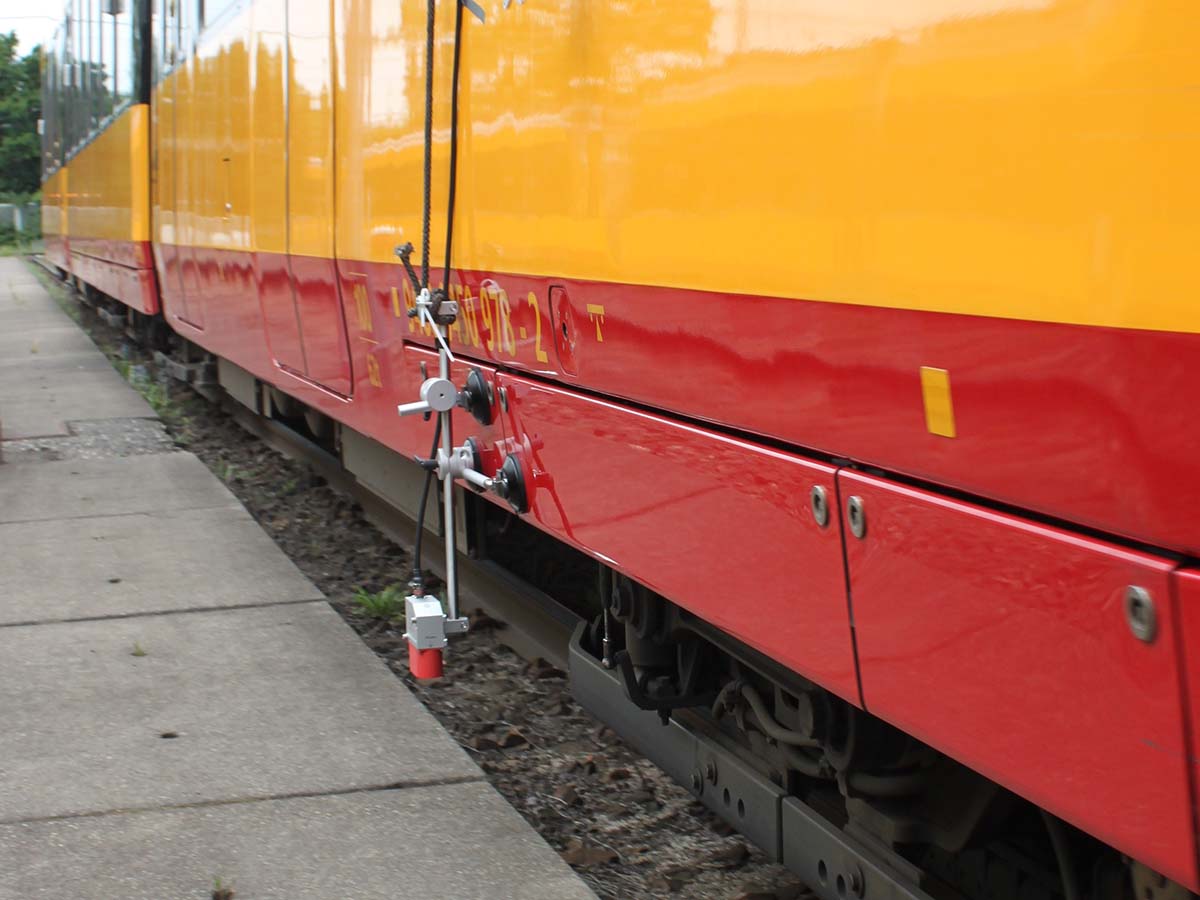
The core of the solution is an optical-inertial sensor that measures speed and distance without contact and without slip. With a speed measurement non-linearity below ±0.1 % FS and consistent repeatability, it provides a reliable data basis for braking distance measurement, even under demanding track, environmental, and weather conditions. Because the sensor relies on neither radar nor GPS reception, it measures in tunnels and depots as well as in rain, ice, and snow.
It mounts flexibly with suction-cup or magnetic mounts, and a single cable for power and data gets it ready quickly.
Data acquisition in a portable case
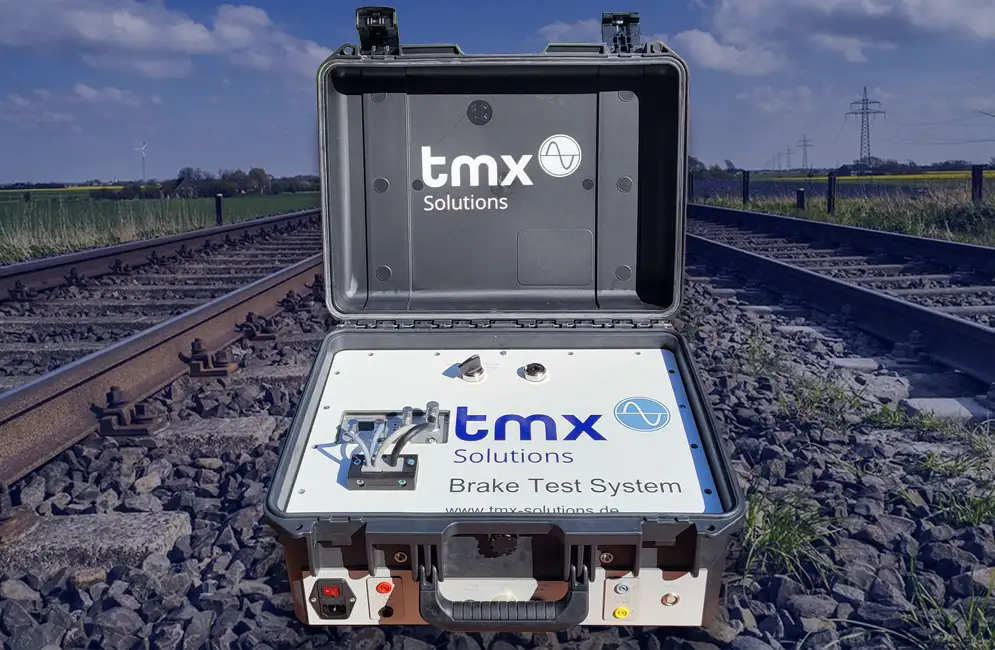
A compact, rugged data acquisition system (DAQ) in a portable, shock-resistant case records the sensor data. Sensor and brake trigger connect directly to its connection panel. Multiple supply voltages (24 V, 110 V, 230 V) let you use the system on a wide range of vehicles.
A built-in battery pack powers the system for several hours without external power. With built-in Wi-Fi, there is no cable clutter between the case and the operating devices.
App-based testing and test report
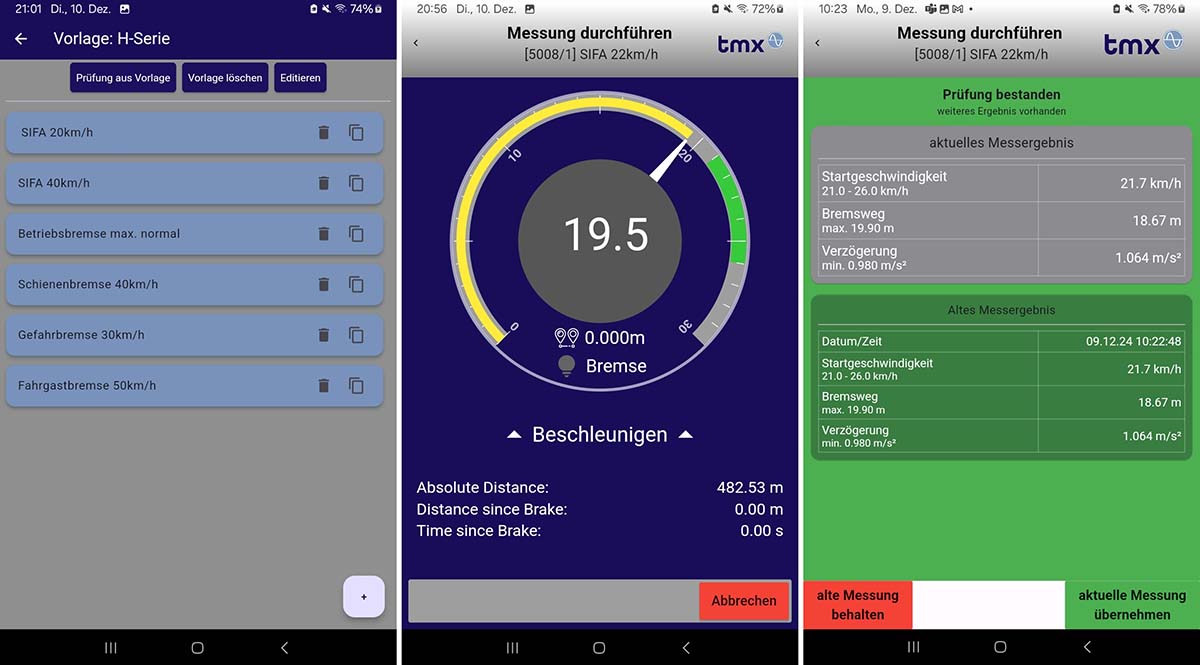
The app-based software is a key part of the solution. It runs on a tablet or smartphone and covers vehicle and test management. In vehicle management, you set up vehicles with fleet numbers, store limits, and define specific test sequences. Test sequences can be set up for different scenarios, from complete brake distance tests under BOStrab to tests of individual brake applications such as emergency braking (see image, left). During the measurement, the live display gives operator and inspector key information, such as the correct speed range (see image, center). Several devices can be used at the same time to support operator and inspector in parallel. Right after braking, the app calculates the results (see image, right). The final step is a tamper-proof PDF test report.
Why do independent, traceable measurement data matter?
After an accident, braking performance becomes a matter of evidence. How fast was the vehicle, how long was the stopping distance, did the brake decelerate as required? These questions decide who is responsible. The answers only hold up if the data were recorded independently and cannot be changed afterward.
For the same reason, periodic testing requires complete documentation. A test report that clearly ties together vehicle, date, speed, stopping distance, and deceleration and is protected against later changes makes every measurement verifiable, with the technical supervisory authority as well as in a dispute.
The TMX BrakeTest system records these values with a calibrated optical sensor and generates a tamper-proof PDF test report. That gives you traceable evidence for every measurement, in routine maintenance as well as after an accident.
Braking distance testing in your operation
Request a quote or an on-site demo in your workshop.