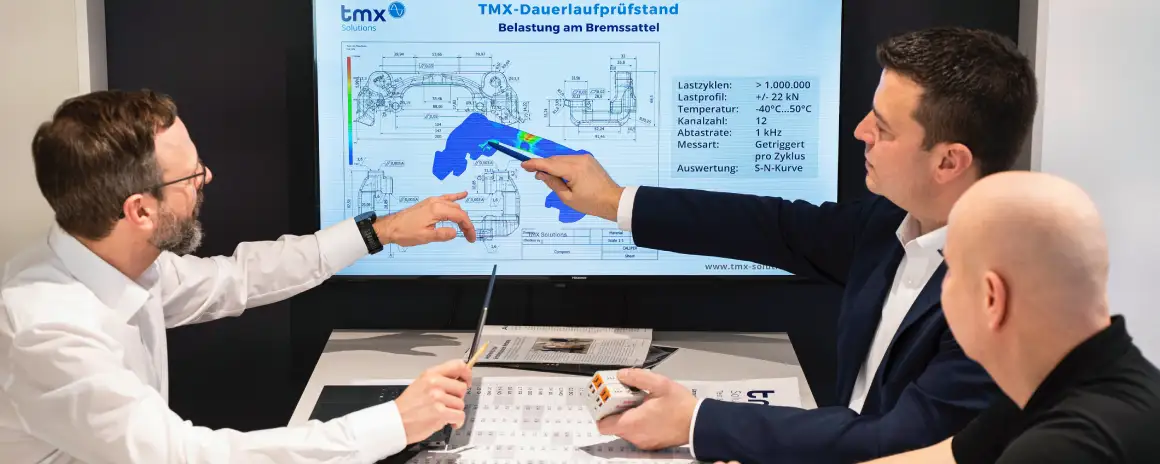
Future-proof test stands:
A test stand is an investment for many years. But what if requirements, standards, or devices under test change, and the test stand no longer fits? Four dimensions decide whether an investment becomes a tool for the next ten years or a costly construction site that needs replacing sooner than planned.
Before the first prototype vehicle rolls, hundreds of components and assemblies must be tested. That takes the right test stands, more precisely component test stands. They bring the road test into the lab: controlled, reproducible, and comparable.
What sounds like a clear task in theory is often more complex in practice. A test stand is bought today and usually has to deliver reliable results for ten years or more. Over that time, test requirements, standards, vehicle platforms, and business models change. If you design a test stand for today's requirements only, you risk that it will not be enough tomorrow.
When test stands don't keep up
A typical scenario: an automotive supplier invests a six-figure sum in a component test stand. After a few years of operation, an OEM arrives with new test requirements: additional load cases, different sensors, changed interfaces. The existing test stand was not designed for this and cannot be expanded. A new investment becomes unavoidable.
Situations like this are expensive and avoidable. Not because anyone can predict the future, but because test stands can be planned to be ready for change. From our daily work with customers in the automotive, rail, and mechanical engineering industries, four dimensions have emerged that decide whether a test stand keeps up with change or not.
Dimension 1: Capture requirements correctly
Many test stands are planned around today's requirements, without looking ahead. That is understandable: today's task is concrete and tangible, the requirements of the day after tomorrow are not. Yet this phase decides how future-proof the entire system will be.
Define requirements independently of proposed solutions
A common mistake in requirements specifications: requirements and solutions get mixed up. Instead of describing what should be tested, the specification defines how it should be tested. That narrows the solution space before the first technical discussion. If you keep requirements separate from proposed solutions, you keep the option to respond more flexibly later.
The range of requirements is wider than you think
Beyond the test task itself, many topics need attention during the requirements phase. Later, they can hardly be added without considerable effort:
- Delivery routes and installation conditions on site
- Foundation and floor load capacity
- Different user levels (operator, setup technician, administrator)
- Interfaces to external systems, such as special measurement systems or ERP and MES connections
- Electrical connections and media supply
- Mechanical interfaces such as DUT adapters and couplings
- Ergonomics: space, working height, mounting and removing devices under test
- Safety concept, including emergency stop, door interlock, and protected zones
- Environmental simulation, if thermal or climatic effects need to be reproduced
- Calibration concept and regular proof of measurement accuracy
At TMX, we use an internal guide that covers these topics in a structured way. We share it with customers during the requirements phase so nothing gets missed.
If you would rather not gather the requirements alone, we can work them out together in a pre-project.
The right questions:
When planning a test stand, ask yourself at least these questions:
- Which standards or test requirements could be added in three years?
- Which related components could be tested on the same test stand in the future?
- What is a must-have, and what is nice to have?
- What life cycle is planned for the system, and which test tasks will realistically be added during that time?
Practical example: test stand for a wheel vector system
A test stand for a wheel vector system (WVS) shows how far-reaching such requirements can be. The device under test is the WVS itself: a measurement system that captures the position of the wheel relative to the chassis in three dimensions and also measures camber angle, steering angle, and suspension travel. It uses optical encoders connected to the wheel via a parallelogram mechanism. The test stand's task is to validate this system under defined, reproducible conditions. To do that, it must simulate wheel movement in all five axes in a controlled way: longitudinal force (braking and accelerating), lateral forces, suspension travel, and steering and camber angles. What sounds manageable at first quickly leads to a list of more than a dozen technical topics in the requirements analysis:
- Stability of the DUT mount
- Repeatability, from the interaction of measurement system and mechanics (axis stiffness)
- Manual adjustment for static positioning of the five axes
- Automatic adjustment with servo motors as an expansion option
- Automatic profile runs between positions
- Open interfaces and CAN bus integration
- Calibration concept
- Safety concept
- Compact design for limited space
- Setup and alignment on site, considered from the start of development
- Cost-effectiveness over the service life
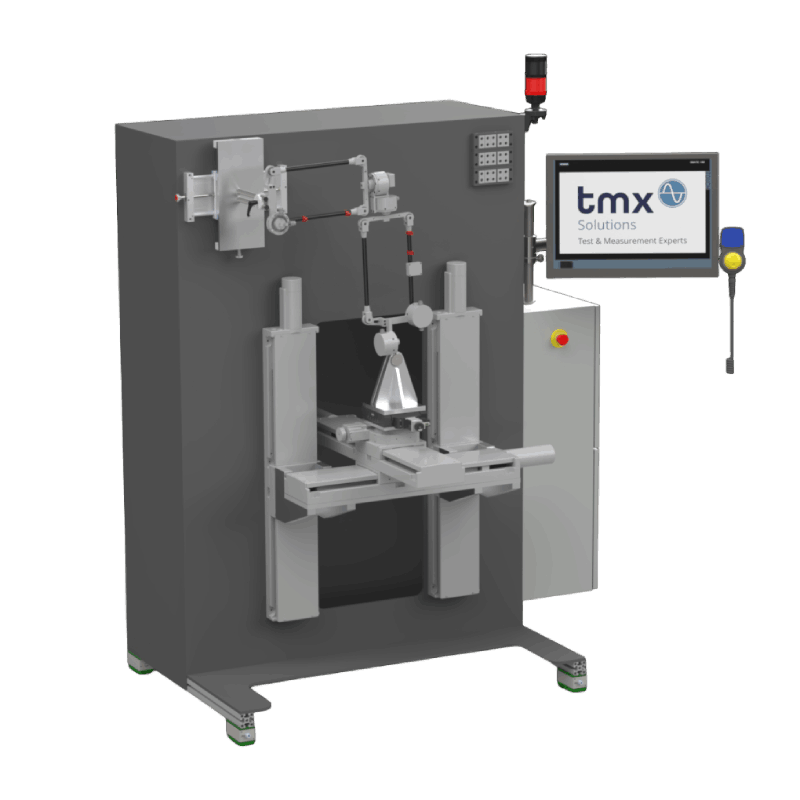
Only once these requirements are clear can viable solution variants be weighed against each other. In this project, two variants remained in the end: a fully automated high-end variant with a preloaded recirculating ball linear guide and 0.01 mm repeatability, and a low-cost manual solution with profile rail guides and 0.5 mm repeatability. Which variant is right is decided by the requirement, not the technology.
Recommendation: Define requirements as independently as possible of specific implementation proposals. The goal is not maximum scope but a viable, cost-effective compromise that leaves room for expansion.
There is no perfect solution. No one can see into the future. Requirements evolve, and the architecture has to cope with that.
Dimension 2: Modularity and openness
Even the best-planned test stand only stays future-proof if it stays open. Closed systems mean vendor lock-in, and with it, long-term limitations that are hard to undo.
Typical problems with closed systems
- Vendor lock-in: expansions, maintenance, and spare parts are tied to one supplier.
- Proprietary systems: only components from the same manufacturer are compatible.
- Inflexible architectures: expansions are complex or impossible.
The right questions:
- Can I integrate other sensors later?
- Can I add measurement channels without replacing hardware?
- Can the system be integrated into my IT landscape?
- Can third-party devices be integrated?
- How can I upgrade the test stand for new devices under test?
Practical example: drive unit test stand at Alstom
A current project at Alstom's Netphen site shows what modularity and openness mean in practice. Alstom runs a service center there for the maintenance and overhaul of bogies. At its center is an enclosed drive unit test stand for the final functional and quality test after overhaul.
The test stand was originally designed for rail drive units whose medium-voltage motor is part of the unit and runs directly on the test stand. As other vehicle platforms became more important, a new requirement arose: motorless drive units, Talent drives from Alstom and Vectron drives from Siemens, also had to be tested on the same test stand. They need an external 400 V auxiliary motor, and the existing 800 kVA medium-voltage system was not suitable for that.
Operation had to stay the same. Trained staff work in three shifts with the existing test sequences, and retraining was not an option. At the same time, the test stand had to be expanded cost-effectively, without setting up a second system.
This expansion was only possible because the architecture of the existing test stand was open. TMX added a modular expansion cabinet with its own 400 V variable frequency drive, its own safety PLC, and full integration into the existing emergency stop circuit. The existing system stayed largely unchanged. The Excel-based test database works as before. Operators follow the same procedures and simply select the test at the control station. Parameter sets switch automatically in the background between Talent and Vectron drives.
The result: a test stand that is now much more flexible and can also handle external test orders, without a new investment. Read more about the Alstom project.
Recommendation: Insist on receiving all project-related source code, configurations, and project files. Avoid black boxes wherever possible, in both the control system and the software. The extra cost pays off at the first expansion at the latest.
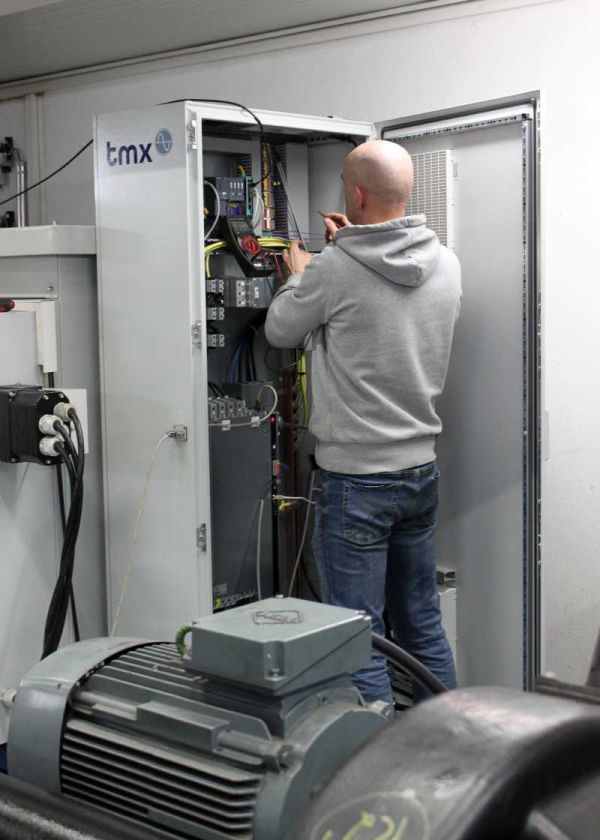
Every black box limits your options. Modularity creates freedom to act. Openness secures the future.
Dimension 3: Scalability
Requirements rarely grow in a straight line; they grow in jumps. One device under test becomes three. A manual test becomes a semi-automated sequence, later a 24/7 endurance run. One test task becomes two, later many more. If you don't consider this when building the test stand, you quickly hit limits that are hard to overcome afterward.
What can scale?
Scalability affects all four levels of a test stand at once:
- Mechanics: installation space, mounts, drives, stiffness of the support structure
- Control: number of axes, I/O channels, bus capacity
- Measurement: number and type of measurement channels, sampling rates, synchronization
- Test stand software: operating concept, data management, interfaces
Practical example: tire test stand
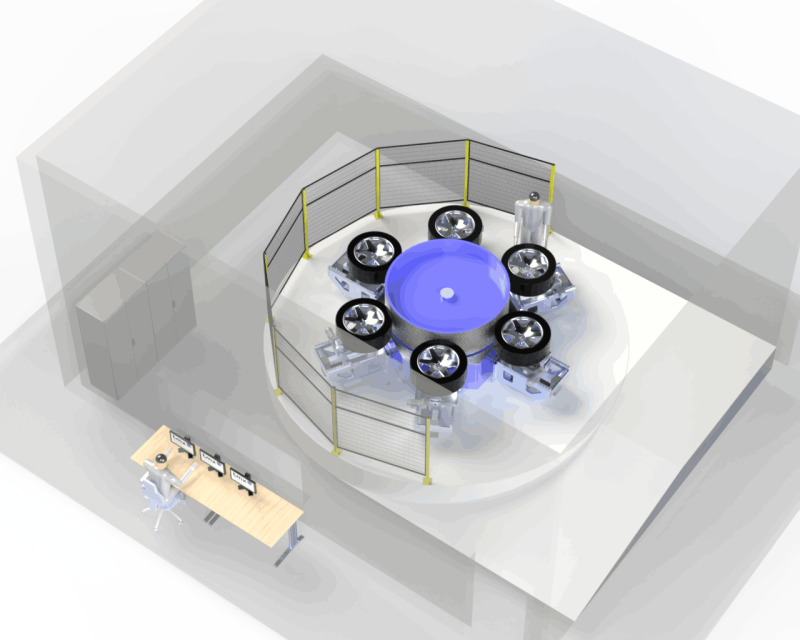
A tire test stand shows how different scaling paths can be. The initial task is simple: test one tire against a drum. But if the test stand is designed for it from the start, you can test one tire on each side of the drum, turning one into two. If you think the scaling question through from the beginning, you can also choose a different architecture: a horizontal roller on which up to six tires are tested at the same time.
The key point: mechanics that need to scale later must be planned for it from the start. A single-position drum cannot be turned into a six-position test stand later. But a setup designed for six positions can start with just one and be expanded later.
The same applies to the test requirements themselves:
- Today: wheel load
- Tomorrow: steering and camber angles as well
- The day after: a wheel force transducer for direct force and torque measurement
And there are many more tasks worth considering long before they become concrete:
- 24/7 continuous operation
- Flat spot or impact testing
- Tread depth measurement
- Acoustic sensors for NVH analysis, such as noise and cavity noise studies
- Tire temperature monitoring
- Combination with a climate chamber to capture thermal effects
- Camera systems for visual assessment
- Multiple drum systems with separate control
- Integration into higher-level test environments
- Connection to simulation databases or digital test records
Recommendation: Define a realistic scaling scenario, not the maximum build-out. Which expansions are plausible in five to ten years? Mechanics, control, measurement, and software should have these reserves from the initial design.
Start small, but think big. How much space, power, and interfaces am I planning today for tomorrow?
Dimension 4: Total cost over the service life
The purchase price is only part of the total cost, and usually not the largest. Over a test stand's typical service life of ten years or more, costs add up that are often underestimated in the investment decision.
The hidden costs
- Calibration and regular maintenance
- Downtime due to missing spare parts
- Operator training when staff change or the system is expanded
- Software updates and support contracts
- Energy consumption over the entire operating life
- Expansion and adaptation costs for new test tasks
The right question
Instead of asking “What does the test stand cost?”, ask “What will the test stand cost me over ten years?”
This perspective often changes how purchasing decisions are evaluated. An open, modular architecture can cost more up front and still be much cheaper over the service life, because it allows expansion without a complete new investment. A supplier with a reliable spare parts concept and long-term software support can also be worth the higher price if it avoids downtime.
Recommendation: Treat the test stand as a capital investment over its entire service life. Ask suppliers about maintenance and calibration effort, spare parts availability, software support periods, and typical expansion paths. These topics belong in the decision, not just in later reality.
Key takeaways
The four dimensions work together. Considering all of them does not give you a perfect test stand; there is no such thing. But it gives you one that stays viable over the years.
- Capture requirements correctly, and plan backward from the life cycle, not forward from today's needs.
- Modularity beats perfection. Openness secures the future.
- Start small, think big: scaling reserves belong in the initial design, not in a later rebuild.
- Operation is part of planning. Calculate over the entire service life, not just the purchase price.
The best compromise is the one that can grow.
Watch the webinar recording
The full webinar “Prüfstände, die mitwachsen” (Future-proof test stands) is available via messweb (in German):
Learn more about TMX test stands
Examples from automotive, rail, and mechanical engineering, from component test stands to functional and endurance test stands:
Talk to an engineer
Discuss your specific task with our engineers.