
Tire abrasion under UN R117: what the drum test demands of test stands
Regulatory status, measurement methods, and requirements for drum test stands under UN R117 and UN R186
Since Supplement 2 to the 04 series of amendments came into force on January 10, 2025, UN R117 includes two methods for measuring tire abrasion: the road convoy and the drum test in the lab. In June 2026, the World Forum WP.29 adopted UN R186, a separate regulation with a limit value. From July 2028, new passenger car tire types must not exceed a defined level of abrasion.
This article summarizes the regulatory status and measurement methods and describes what UN R117 and UN R186 require of a drum test stand. It is written for test institutes, tire development teams, and universities that want to run abrasion tests themselves.
On this page
- What does UN R117 regulate on tire abrasion?
- When do the reporting requirement and the limit apply?
- How is tire abrasion measured?
- How much tire abrasion is normal?
- Road convoy or drum: how do the methods differ?
- What must a drum test stand under Annex 10 be able to do?
- What does abrasion testing require of the test cell?
- How does a test facility prove equivalence?
- Can an existing drum test stand be converted?
Regulation
What does UN R117 regulate on tire abrasion?
UN R117 governs the type approval of tires. Since January 2025, it has included Annex 10 with two equivalent methods for determining the abrasion of C1 passenger car tires. The method measures the tire's mass loss over a defined distance, relative to the load and to a reference tire. For new tire types, reporting the value is mandatory from January 1, 2027.
Until the end of 2024, the regulation covered rolling noise, wet grip, and rolling resistance. Supplement 2 to the 04 series of amendments added Annex 10, published in the Official Journal of the EU as 2025/1453. Method a is the road convoy, method b the drum test.
Don't confuse abrasion with another change in the 04 series: since July 2024, wet grip must also be proven on tires artificially worn down to 2 mm tread depth. This test concerns safety up to the wear limit. It has nothing to do with abrasion as an emission.
Deadlines
When do the reporting requirement and the limit apply?
Reporting abrasion under UN R117 is mandatory for new type approvals of C1 tires from January 1, 2027. The limit is set by a separate regulation, UN R186, which WP.29 adopted in June 2026: from July 1, 2028, the abrasion index of new types must not exceed 1.00; from June 30, 2030, this applies to all types.
| Date | What applies |
|---|---|
| Jan 10, 2025 | UN R117, Supplement 2 to the 04 series of amendments enters into force; Annex 10 with two measurement methods |
| Jan 1, 2027 | Reporting the abrasion rate becomes mandatory for new type approvals of C1 tires |
| expected January 2027 | UN R186 on tire abrasion enters into force |
| Jul 1, 2028 | Stage 1: limit AICT ≤ 1.00 for new tire types, normal and snow tires |
| Jun 30, 2030 | Stage 1 for all tire types |
| Jul 1, 2033 / Jun 30, 2035 | Stage 2 for new types / for all types |
Allowances and deductions apply to certain tire groups and add up. In Stage 1, extra load tires (XL) and snow tires with the three-peak mountain snowflake symbol (3PMSF) each receive an allowance of 0.10. In Stage 2, the limit for standard load tires drops to 0.90.
The Euro 7 regulation (EU) 2024/1257 adds tire abrasion to emission rules. From July 1, 2028, new passenger car tire types will only be approved if they meet the requirements. The European Commission sets measurement methods and limits based on the work of WP.29, that is, on the UN regulations. According to the responsible UNECE working group, the limits will reduce abrasion by more than 10 percent. About 30 percent of the tires sold in Europe and Japan today would not meet them.
Measured quantities
How is tire abrasion measured?
Tire abrasion is measured as mass loss. The tire is weighed before and after the test, and the loss is related to distance and load. This gives the load-normalized abrasion rate in mg/km/t. The abrasion index AICT relates it to a reference tire that runs under the same conditions.
UN R117 works with three quantities:
- Abrasion rate in mg/km: mass loss of the tire per kilometer
- Load-normalized abrasion rate in mg/km/t: abrasion rate relative to load, so tires with different load capacities can be compared
- Abrasion index AICT: load-normalized abrasion rate of the candidate tire relative to that of the reference tire
For the limit, UN R186 adds two corrections: drum results are converted to the road method (see equivalence), and a fixed deduction accounts for the uncertainty of the measurement methods.
Standardized reference test tires in size 225/45 R17 serve as the reference, known as SRTT (Standard Reference Test Tyre). ASTM standards define their production, testing, and storage. The SRTT17S (ASTM F3676) applies to normal tires, the SRTT17W (ASTM F3675) to snow tires. The reference tires are made and sold exclusively by Michelin and are ordered through the procedure published by ETRTO and ASTM.
Relating results to the reference tire cancels out influences that affect both tires equally, such as the weather or the condition of the test drum. A ratio below 1 means less abrasion than the reference.
Typical values
How much tire abrasion is normal?
In city traffic, a passenger car loses 120 to 240 mg of tire material per kilometer across all four tires, and much less on the highway. That is about 30 to 60 mg/km per tire. These figures come from test drives by TU Ilmenau for the German Environment Agency (UBA). Pulling away, braking, and tight curves drive abrasion the most; outside temperature is a major disturbance variable.
The 2022–2023 measurement campaign (UBA Texte 137/2025) used a front-wheel-drive passenger car, four summer tires, and one reference tire, each over about 2,700 km. In urban driving, values for the whole vehicle ranged from 126 to 239 mg/km, with the reference tire at 166 mg/km. On the highway, the vehicle with reference tires reached about 44 mg/km.
The ranking of the tires was not the same in every driving profile. The abrasion rate also fell with increasing mileage, because new tires first have to wear in. For test methodology, this means the cycle and reference tire must be precisely defined.
Methods
Road convoy or drum: how do the methods differ?
In the road convoy, several vehicles with candidate and reference tires drive about 8,000 km on public roads. In the drum test, the tire runs about 5,000 km on a drum with a rough surface while forces and speed are controlled to a fixed cycle. The UN regulation treats both methods as equivalent.
| Road convoy (method a) | Drum test (method b) | |
|---|---|---|
| Test distance | 8,000 km ±300 km | 5,044 km in 20 cycles |
| Test duration | several days to weeks with drivers and vehicles | just under 69.5 hours of running time per run |
| Running surface | public roads | drum with textured surface |
| Disturbance variables | weather, temperature, traffic, driving style | temperature window 25 °C ±3 °C, snow tires 20 °C ±3 °C, surface condition |
| Reference tire | in the same convoy | simultaneously (two positions) or alternating (one position) |
Equivalence remained disputed until the end. In 2025, parts of the tire industry saw only a weak correlation between road and drum and wanted to allow the drum only as a proven alternative. A correlation study showed better values, and the regulation now treats both methods equally. In return, every test facility must prove its equivalence.
Test stand
What must a drum test stand under Annex 10 be able to do?
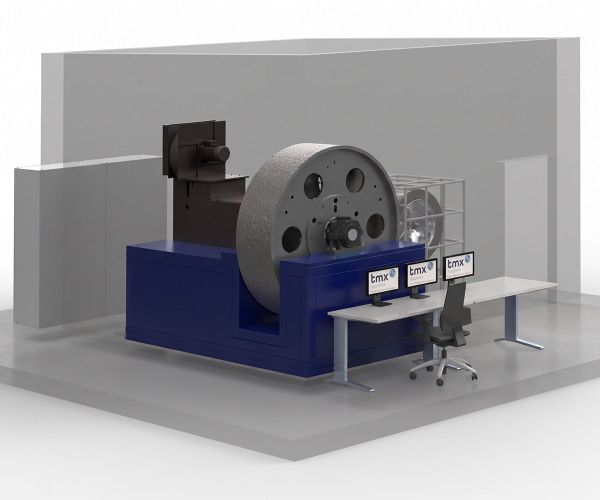
A drum test stand under Annex 10 needs a drum at least 3 m in diameter with a defined roughness. It must dynamically control lateral and longitudinal forces on the tire according to the test cycle and record them at 10 Hz or more. Add to that powder dosing at the contact patch, a narrow temperature window, and a scale accurate to ±2 g.
The requirements are set out in UN R117 Annex 10 and in Annex 3 of UN R186, which governs the limit. Where the two differ, we give the stricter values of R186.

Drum and surface
The drum must be at least 3 m in diameter. Its surface is rigid and textured with sand, stones, or aluminum oxide in resin; abrasive paper is permitted. The mean profile depth (MPD) of the surface must not exceed 2.0 mm, and microroughness is limited as well. Both are measured to ISO 13473.
The reference tire shows whether the surface is right: its load-normalized abrasion rate must fall within a defined range (between 45 and 135 mg/km/t for a normal tire). On a 3 m drum, the abrasive paper is changed after 20,000 km (two positions) or 40,000 km (one position).
Force control and test cycle
The test cycle specifies speed and longitudinal and lateral acceleration over time. The target forces are calculated from these accelerations and the wheel load. Lateral force is set via the slip angle, longitudinal force via drive or braking torque.
One cycle lasts 12,490 s, just under 3.5 hours. It starts at 60 km/h and runs mainly at 100 km/h. Acceleration values reach about ±0.33 g longitudinally and ±0.2 g laterally. The test runs 20 cycles; in total, UN R186 requires a test distance of 5,044 km.
| Quantity | Permitted deviation |
|---|---|
| Wheel load Fz | ±50 N or 1 % |
| Lateral force Fy, longitudinal force Fx | ±100 N or 5 % |
| Moment My | ±40 Nm or 5 % |
| Camber | 0° ±0.1° |
| Speed | control ±2 km/h, measurement ±0.1 % |
| Force measurement | ±1 % of full scale |
| Ambient temperature | ±3 °C |
| Inflation pressure | ±3 kPa |
Test program
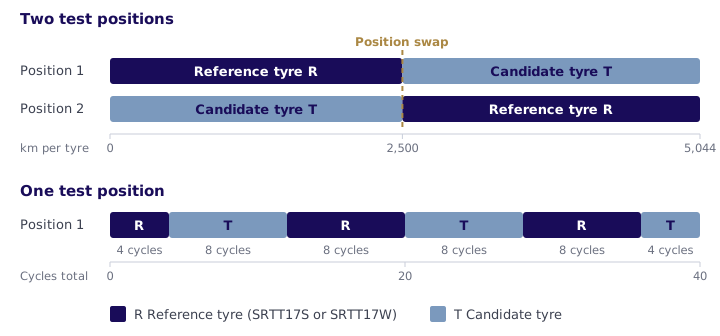
Reference and candidate tires run the same cycle. In the standard program, both sit on a drum with two test positions and run at the same time. After 2,500 km they swap positions, which evens out differences between the positions. If the drum has only one position, the tires alternate: reference tire 4 cycles, candidate tire 8, reference tire 8, candidate tire 8, reference tire 8, candidate tire 4. Each tire thus reaches 20 cycles, and both are spread over the entire test duration. The drum runs twice as long, just under 139 hours.
Measurement and recording
Lateral force, longitudinal force, or torque are recorded at 10 Hz or more; wheel load, speed, and ambient temperature at 1 Hz or more. The tire is weighed before and after the test, with a scale accurate to ±2 g. Inflation pressure is measured before the test and no earlier than three hours after it. MPD and microroughness of the drum are measured before and after each test.
Powder dosing
To keep rubber particles from sticking to the drum, fine talc or silicon dioxide is applied near the contact patch. Each tire receives 40 to 200 g/h. Reference and candidate tires must receive almost the same amount, and the rate must stay constant throughout the test. Annex 3 of UN R186 specifies tolerances and nozzle position.
Test conditions
The tire runs at 80 % of its maximum load capacity. Inflation pressure is 210 kPa for standard load and 250 kPa for extra load tires; it is set before the test and not readjusted. Ambient temperature is 25 °C (±3 °C), or 20 °C (±3 °C) for snow tires. The mean values for reference and candidate tires may differ by no more than 2 °C. Before the test, the tires are conditioned for at least three hours at 17 to 28 °C.
Validation and test report
A test is only valid if the cycle was actually driven. This is proven via the measured accelerations: their mean values must lie within a narrow tolerance band around the cycle's target values. If a reference tire loses more than 1 cm² of tread through chunking, the test is also invalid. Under UN R186, the test report contains 27 mandatory items, including drum condition, tire data, masses before and after the test, the abrasion index, and the deduction applied.
Test cell
What does abrasion testing require of the test cell?
Annex 10 does not prescribe a specific test cell. But powder dosing, the temperature window, and occupational safety lead to a dust-tight enclosure with extraction and to air conditioning that removes friction and drive heat over about 69 hours. Weighing requires a dust-free station with its own temperature control.
The following points are not stated word for word in the regulation. They follow from its requirements and from occupational safety.
Fine rubber particles and the release powder get into the room air. The extraction system is therefore designed with filters according to the German Technical Rules for Hazardous Substances (TRGS 559 for quartz-containing dust, TRGS 900 for occupational exposure limits). The enclosure surrounds the drum and loading units.
Friction power at the contact patch and drive losses go into the room as heat over the entire running time. The air conditioning must remove it so that the required 25 °C (±3 °C) is held near the tire. If you also test snow tires, you must be able to switch the room to 20 °C (±3 °C). Conditioning and weighing take place outside the enclosure. A test stand of this size typically also needs noise protection.
Equivalence
How does a test facility prove equivalence?
UN R186 accepts road convoy and drum on equal terms. In return, every test facility must take part in a comparison test under Annex 4 before it may deliver results for type approval. It tests the same tire types as facilities already recognized or test tracks for the road method. If its results are close enough to their mean values, it is considered equivalent.
A coordinating body organizes the comparison test. This can be a Technical Service, the Type Approval Authority, a facility already deemed equivalent, or the facility under assessment itself. The body collects the results, calculates the comparison values, and submits an equivalence report to the Type Approval Authority. The proof runs in three steps:
- Select tires and participants
- At least six tire types with clearly different abrasion, with a balanced mix of normal and snow tires. Plus at least one facility already recognized, or at least three test tracks for the road method.
- Form comparison values
- Each participating facility tests each tire at least once under Annex 3. The comparison value per tire is the mean. Results deviating from it by more than 0.25 are excluded.
- Prove equivalence
- The facility under assessment compares its results with the comparison values. Each tire may deviate by no more than 0.25, and the root mean square error across all tires (RMSE) by no more than 0.12.
Before comparison, drum results are converted to the road method using a coefficient. Without a facility-specific value, a general value applies. A drum can also have its own coefficient determined in an extended comparison test; it then applies only to that system.
Recognition applies to the test parameters the facility used in the comparison test. If they change, the Type Approval Authority must agree. If you are setting up a test facility, design the measurement chain and control system so that parameters can be documented traceably and raw data are kept in full. The regulation does not require regular repetition. The proof applies to the system, not to individual tire types. Facilities whose data went into developing the regulation are already considered equivalent; they are listed in UNECE document GRBP-83-50-Rev.1. Until July 1, 2028, their results obtained since February 2024 may serve as comparison values.
Conversion
Can an existing drum test stand be converted?
An existing drum test stand can be converted if the drum is at least 3 m in diameter. That can be the case with endurance test stands and high-speed test stands. Rolling resistance test stands, by contrast, usually use 2 m drums. Typically, force control, a fast measurement chain, cycle control, powder dosing, and the test cell need to be added.
The following components are usually affected by a conversion:
- Loading unit:
- slip angle actuators for lateral force, drive or braking torque for longitudinal force – more about the loading unit
- Wheel force transducer:
- forces and moments, recorded at 10 Hz or more
- Control system:
- runs the test cycle and proves it was followed
- Powder dosing:
- with enclosure and extraction
- Surface measurement:
- MPD and microroughness of the drum to ISO 13473
- Temperature control:
- in the test cell and at the weighing station
- Test report:
- generated automatically with the mandatory items under UN R117 and UN R186
Mechanics, drive, and drum usually stay. Existing measurement and control technology can often be reused or extended, as long as it can control and record the forces fast enough. A comparison with the existing system shows what actually needs to change or be replaced. After the conversion, the operator must prove equivalence with its own comparison tests. This requires a fully documented measurement chain with traceable calibration.
Your inquiry about tire abrasion test stands
TMX Solutions designs and builds tire test stands vendor-independent, as new builds or as conversions of existing systems. For abrasion testing under UN R117, we work out with you whether your drum meets the requirements and which building blocks are missing.
Sources
- UN Regulation No. 117, Rev. 6, Supplement 2 to the 04 series of amendments, Annex 10 and Appendices 3 to 6. Official Journal of the EU, L 2025/1453, August 7, 2025
- UN Regulation No. 186 on the approval of tyres with regard to their abrasion performance, adopted at the 199th session of WP.29, June 2026. Text: ECE/TRANS/WP.29/2026/138, Annexes 3 and 4
- GRBP-83-50-Rev.1: List of equivalent test facilities
- German Environment Agency (UBA, ed.), Bachmann/Feist (TU Ilmenau): Reifen- und Bremsenabrieb bei leichten Straßenfahrzeugen (tire and brake wear of light road vehicles, in German). UBA Texte 137/2025
- Regulation (EU) 2024/1257 (Euro 7), Articles 2, 11, 14, and 15
- ASTM F3676 and F3675: specifications of the reference tires SRTT17S and SRTT17W. Ordering procedure: ETRTO, SRTT Order, https://www.etrto.org/useful/srtt-order/
- ISO 13473-1 and -3: Characterization of pavement texture by use of surface profiles
- DieselNet, news of March 26, 2026, on UNECE abrasion limits: https://dieselnet.com/news/2026/03unece.php